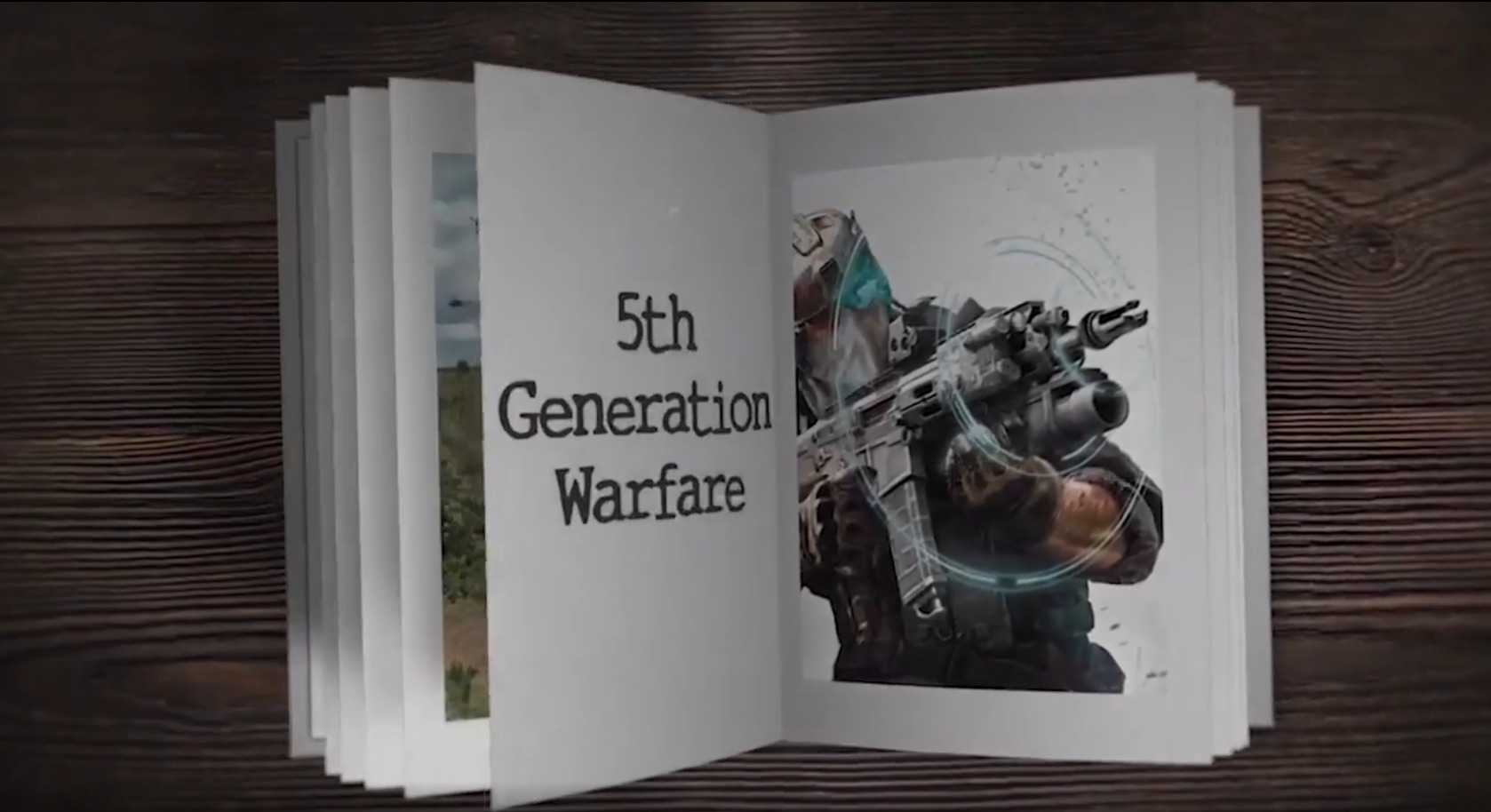
The line between “civilian” and “military” become blurred
We are in the middle of a world-changing war. This is no ordinary war, however. Most of the victims of this warfare aren’t even able to identify it as war, nor do they understand that they are combatants in it. It’s called fifth-generation warfare, and I’m here to tell you all about it. . . .
Psychological operations are more important than ever
In a nutshell, Lind et al.’s thesis is that the “modern age” of warfare began with the Treaty of Westphalia in 1648, which, Lind opines, “gave the state a monopoly on war.” From that point on, modern warfare went through three generations, namely:
- First-generation warfare: the tactics of line and column, developed in the era of the smoothbore musket;
- Second-generation warfare: the tactics of indirect fire and mass movement, developed in the era of the rifled musket, breechloaders, barbed wire and the machine gun; and
- Third-generation warfare: the tactics of nonlinear movement, including maneuver and infiltration, developed in response to the increase in battlefield firepower in WWI.
This, according to Lind and his co-authors, brought us to the late-20th century, when the nation-state began to lose its monopoly on war and military combat returned to a decentralized form. In this era—the era of fourth-generation warfare—the line between “civilian” and “military” become blurred, armies tend to engage in counter-insurgency operations rather than military battles, and enemies are often motivated by ideology and religion, making psychological operations more important than ever.
But, some argue, we have now entered a new era of warfare, namely fifth-generation warfare.
There is still much debate about what defines fifth-generation warfare, how we know we’re engaged in it, or even if it exists at all (Lind, for one, rejects the concept). Various scholars have made their own attempts at defining fifth-generation warfare (5GW), like Dr. Waseem Ahmad Qureshi, who identifies it as “the battle of perceptions and information,” or Qiao Liang and Wang Xiangsui of the People’s Liberation Army, who write of the era of “Unrestricted Warfare” in which “a relative reduction in military violence” has led to “an increase in political, economic, and technological violence.”
If academic debates about the changing nature of warfare are your thing, then there’s plenty of reading for you to do on the subject, from The Handbook of 5GW: A Fifth Generation of War? to a slew of academic articles.

Corbett Report
www.corbettreport.com/5thgen
Weitere Meldungen
- Rep. Tim Burchett Says "Names, Dates, People And Locations" Set To Be Revealed In UFO Briefings
- Why Is China's Embassy In D.C. Hardening Security Perimeter With Barbed Wire
- The Iran War Has Been A Catastrophe For The US — But Israel Wants More
- 'Next Step Mars': Trump Congratulates Artemis II Astronauts On Historic Lunar Mission
- Orban Warns "We Could Now Lose Everything": Sunday's Hungarian Elections Have Profound Implications For Europe
- Three Contrarian Signals That Aren't Easy To Ignore As Earnings Season Begins
- Watch: Axe-Wielding Man Attacks U.S. C-130 Cargo Plane At Irish Airport
- Trump Announces Start Of "Clearing Out" The Strait As A "Favor" To RoW As 'Indirect' Talks With Iran Continue
- Swalwell Denies Rape Allegations - Refuses to Drop Out Of Governor's Race Despite Democrat Exodus
- Angekündigte Apokalypsen
- HIPPO Turns One Master Password Into Many Without Storing Any
- Does Blowing Up Data Centres Make Iran “the Real Resistance”?
- Jury Trials Are Vital to the Constitutional Order
- Promethean Science • Why the Empire Hates Trump’s Moon Mission (Astrospheric Man, Part 1)
- Ungarns Wahl: Festung Orbán gegen Modell Magyar