

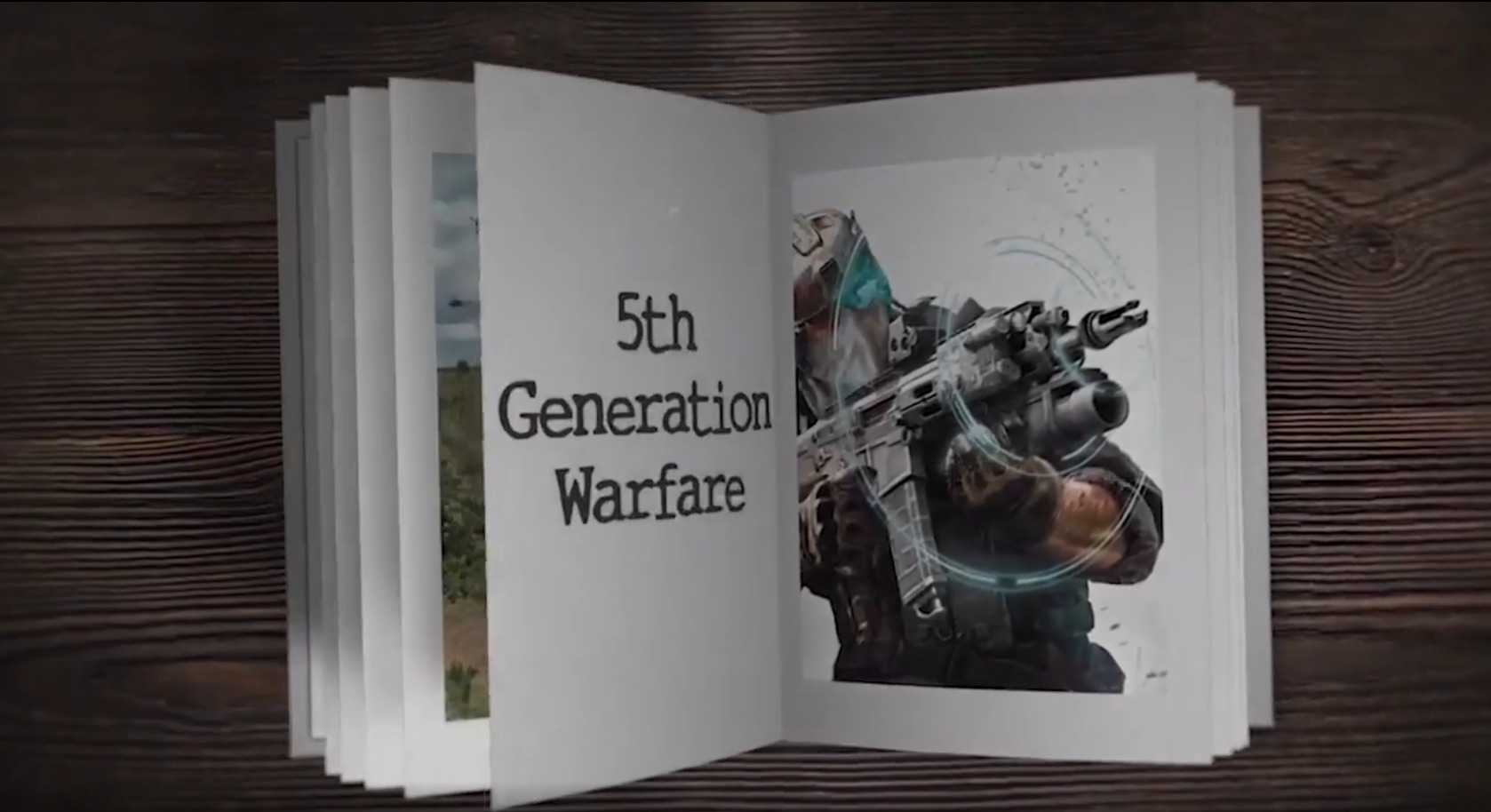
The line between “civilian” and “military” become blurred
We are in the middle of a world-changing war. This is no ordinary war, however. Most of the victims of this warfare aren’t even able to identify it as war, nor do they understand that they are combatants in it. It’s called fifth-generation warfare, and I’m here to tell you all about it. . . .
Psychological operations are more important than ever
In a nutshell, Lind et al.’s thesis is that the “modern age” of warfare began with the Treaty of Westphalia in 1648, which, Lind opines, “gave the state a monopoly on war.” From that point on, modern warfare went through three generations, namely:
- First-generation warfare: the tactics of line and column, developed in the era of the smoothbore musket;
- Second-generation warfare: the tactics of indirect fire and mass movement, developed in the era of the rifled musket, breechloaders, barbed wire and the machine gun; and
- Third-generation warfare: the tactics of nonlinear movement, including maneuver and infiltration, developed in response to the increase in battlefield firepower in WWI.
This, according to Lind and his co-authors, brought us to the late-20th century, when the nation-state began to lose its monopoly on war and military combat returned to a decentralized form. In this era—the era of fourth-generation warfare—the line between “civilian” and “military” become blurred, armies tend to engage in counter-insurgency operations rather than military battles, and enemies are often motivated by ideology and religion, making psychological operations more important than ever.
But, some argue, we have now entered a new era of warfare, namely fifth-generation warfare.
There is still much debate about what defines fifth-generation warfare, how we know we’re engaged in it, or even if it exists at all (Lind, for one, rejects the concept). Various scholars have made their own attempts at defining fifth-generation warfare (5GW), like Dr. Waseem Ahmad Qureshi, who identifies it as “the battle of perceptions and information,” or Qiao Liang and Wang Xiangsui of the People’s Liberation Army, who write of the era of “Unrestricted Warfare” in which “a relative reduction in military violence” has led to “an increase in political, economic, and technological violence.”
If academic debates about the changing nature of warfare are your thing, then there’s plenty of reading for you to do on the subject, from The Handbook of 5GW: A Fifth Generation of War? to a slew of academic articles.
Corbett Report
www.corbettreport.com/5thgen
Weitere Meldungen
- The Turd-Eaters: France Gives Us A Lesson On The Pillager Class
- Israel Detains NY Congressional Nominee In West Bank Olive Grove, Sets Free After Learning Who He Is
- Ukraine's Anti-Graft Cops Raid The Central Bank... So Where's The Gold?
- How The NYT Hid Big Pharma PR Titan Jack Leslie In Plain Sight
- Pezeshkian Now Says Sanctions Must Be Peeled Off Before US Dialogue Returns
- Oz Says HHS Is Deferring $1.2 Billion More From California Medicaid Funding
- Donald Trump Jr. Privately Breaks With His Father On Foreign Policy: Report
- Hochul Weighs Ending $500 Million Medicaid Adult Day Care Program After Fraud Raids
- «Die Windkraft-Lüge»: Neues Buch entlarvt die Folgen der Windkraft
- Angriff auf das Informationsfreiheitsgesetz ohne Belege – «nix, nirgends»
- Linksextreme Netzwerke, gewaltbereite migrantische Milieus und Frankreichs Schuldenkrise: Wer treibt das Land an den Abgrund?
- Britische Regierungsbeamte als Journalisten und «Faktenchecker» bei der «BBC» tätig
- Frankreich: Attal fordert Sperrung sozialer Medien bei Krawallen
- Federico Faggin: Die Verschmelzung von Wissenschaft und Spiritualität, Quantenphysik, Sinn und freiem Willen
- Ist Bewusstsein fundamental?


