


A Framework – BioDigital Convergence
Anwendungen von Digital Twins im Gesundheitswesen ist nur das Einfallstor
Stand der Forschungen dieses Dokuments sind aus dem Jahr 2023 – das bedeutet mit Hilfe von AI ist die Beschleunigung so gross, das im Jahr 2026 mit sehr grossen Schritten gerechnet werden kann…
Das Internet der Dinge (Internet of Things, IoT) ermöglicht „intelligentere“ Umgebungen in zahlreichen Branchen. Zusammen mit Digital-Twin-Technologien (DTw) zeigt es ein sich entwickelndes Potenzial, nicht nur bestehende Dienstleistungen zu optimieren, sondern auch neue zu schaffen.
Der Zweck dieser Präsentation ist es, einen einführenden Überblick über die Anwendungen dieser Konzepte und Technologien im Gesundheitswesen zu geben.
- The Internet of Things
– ICT Technologies integrated in IoT Systems - IoT Healths applications
- Digital Twin overview
- Digital Twin applications
- Conclusion
Weitere Themen-:Artikel
https://lohas-magazin.de/tag/iobnt
DOKUMENT – Slides PDF
 Loading...

 Reload document
  Open in new tab
Internet of Things – what are Implantable Bioelectronic Devices?
Human Interaction and Emerging Technologies
Accelerating Open Access Science in Human Factors Engineering and Human-Centered Computing
www.openaccess.cms-conferences.org/publications
Anti-Reflective Zeolite Coating for Implantable Bioelectronic Devices
In the last decade, research has driven a series of technological innovations in the fields with even more increasing energy demand [1,2,3,4]. This is evident in industrial technologies characterized by huge energy consumption (e.g., healthcare, automotive, consumer electronics, industrial, etc.) [5,6]. In healthcare modern diagnostic approaches and therapies, implantable bioelectronic devices can improve the clinical outcome of the patient, obtaining a large amount of data [7,8,9]. Innovative devices are usually light, allowing the patient to conduct normal daily activities [10,11,12]. Energy storage is by far one of the bottlenecks, preventing efficient energy management [13]. The latest designed batteries could even last for years, also thanks to energy harvesting techniques that collect energy from external sources [14,15]. Thus, the evolution of medical electronic devices is aimed at the reduction of energy consumption (in the order of μW or less) and the simultaneous harvesting of energy from the environment (e.g., solar cells, piezoelectric generators, triboelectric generators, radio frequency harvesters, thermo-electric conversion, etc.)
https://www.mdpi.com/2306-5354/9/8/404
Human Interaction, Emerging Technologies and Future Systems V
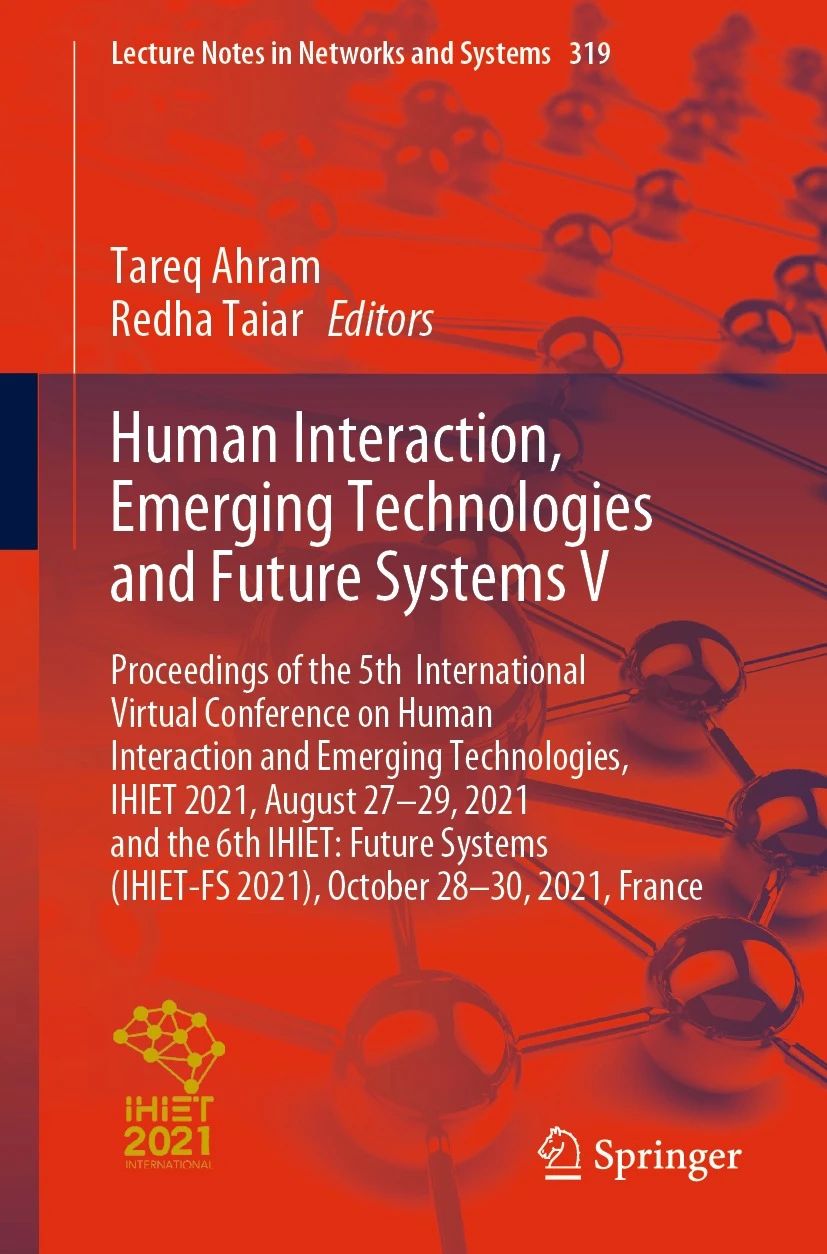 Proceedings of the 5th International Virtual Conference on Human Interaction and Emerging Technologies, IHIET 2021, August 27-29, 2021 and the 6th IHIET: Future Systems (IHIET-FS 2021), October 28-30, 2021, France
Editors: Tareq Ahram, Redha Taiar
Reports on cutting-edge research and developments on human–machine interaction
Focuses on human-centered design approaches
Covers established and emerging applications
This book reports on research and developments in human–technology interaction. A special emphasis is given to human–computer interaction and its implementation for a wide range of purposes such as health care, aerospace, telecommunication, and education, among others. The human aspects are analyzed in detail. Timely studies on human-centered design, wearable technologies, social and affective computing, augmented, virtual and mixed reality simulation, human rehabilitation, and biomechanics represent the core of the book. Emerging technology applications in business, security, and infrastructure are also critically examined, thus offering a timely, scientifically grounded, but also professionally oriented snapshot of the current state of the field. The book gathers contributions presented at the 5th International Conference on Human Interaction and Emerging Technologies (IHIET 2021, August 27–29, 2021) and the 6th International Conference on Human Interaction and Emerging Technologies: Future Systems (IHIET-FS 2021, October 28–30, 2021), held virtually from France. It offers a timely survey and a practice-oriented reference guide to researchers and professionals dealing with design, systems engineering, and management of the next-generation technology and service systems. SPRINGER
International Conference on Human Interaction & Emerging Technologies 2026
IHIET-AI Conference aims to provide a global forum for presenting and discussing novel human-interaction, healthcare, sport medicine and engineering approaches, tools, methodologies, techniques, and solutions for integrating people, concepts, trends and applications in healthcare and artificial intelligence all areas of human interaction endeavor in industry, economy, government, and education, including but not limited to energy, transportation, urbanization and infrastructure development, digital manufacturing, social development, human health, sustainability, new generation of service systems, as well as safety, risk assessment, healthcare, and cybersecurity in both civilian and military contexts.
IHIET-AI Conference will focus on advancing the theory and applications for human-interaction requirements as part of an overall system and product solution, by adopting a human-centered design approach that utilizes and expands on the current knowledge of user-centered design and systems engineering supported by cognitive software and engineering, data analytics, simulation and modeling, and next generation visualizations. This interdisciplinary conference will also expand the boundaries of the current state-of-the-art by investigating the pervasive complexity that underlies the most profound problems facing contemporary society today.
Emerging technologies include a variety of technologies such as educational technology, information technology, nanotechnology, biotechnology, cognitive science, robotics, and artificial intelligence.
Artificial Intelligence & Future Applications
April 23-25, 2026, Universitat Politècnica de València, València, Spain
Conference on Human Interaction & Emerging Technologies: Future Systems and Design Applications
June 22-24, 2026, Kodolányi University, Budapest, Hungary
www.ihiet-fs.org/index-fs.html
International Conference on Human Interaction & Emerging Technologies (IHIET 2026)
August 25-27, 2026, Università Iuav di Venezia, Venice, Italy
www.ihiet.org/index-ihiet.html
Der digitale Zwilling
Die COVID-19-Pandemie hat die digitale Transformation weltweit weiter beschleunigt , die nun in einer Vielzahl groß angelegter Initiativen zur planetaren Gesundheit Anwendung findet . In der Europäischen Kommission ist Destination Earth (DestinE) eine aktuelle und bedeutende Initiative zur Entwicklung eines hochpräzisen digitalen Modells der Erde (eines „ digitalen Zwillings “) .
Dass niemand gefragt wurde, ob das überhaupt gewünscht sei, spielt keine Rolle. Ebenso wenig, dass jahrelang daran gearbeitet wurde, bevor dieses Papier veröffentlicht wurde. Auch die Tatsache, dass es von Lügnern durchgesetzt wurde, die sich mit Versprechungen von „ guter Regierungsführung “, „ Transparenz “ und „ Rechenschaftspflicht “ brüsteten , aber nicht nur kein Problem darin sehen, dass die angebliche „ Präsidentin “ aktiv Informationen über Textnachrichten zwischen ihr und dem Pfizer-CEO Albert Bourla vernichtet , nein, die Europaabgeordneten entscheiden sogar, dass dies nicht nur für ihre Entlassung (geschweige denn für eine Strafverfolgung) nicht ausreicht , sondern wählen sie kurz darauf sogar wieder.
There is much much more to see, overwhelming Surveillance NanoTech…
#IoBNT The Internet of Bio Nano Things. #6G networks…
Made in #Germany? #IoBNT The Internet of Bio Nano Things. #BMBF Babylon Berlin > Communication platform to connect the human body with #6G networks… There is much more from UN ITU Geneva IEEE WEF WHO #Biodigital
🚨INTERNET OF BIO-NANO THINGS🚨🎯
NOTE: Source links ⬇️ pic.twitter.com/ZswXhgXW6q— Kristie Iushkova 🌺 (@KristieIushkova) January 24, 2025
Resources
S.5002 – FDA Modernization Act 2.0117th Congress (2021-2022) https://www.congress.gov/bill/117th-congre…
Supervised Machine Learning Algorithms for Bioelectromagnetics: Prediction Models and Feature Selection Techniques Using Data from Weak Radiofrequency Radiation Effect on Human and Animals Cells https://pmc.ncbi.nlm.nih.gov/articles/PMC7…
Biofield https://en.wikipedia.org/wiki/Biofield
Digital nervous system integration and implementation of machine learning https://www.researchgate.net/figure/Digita…
The challenge of designing in-body communications https://www.google.com/search?sca_esv=f886…
Intra-body communications for nervous system applications: Current technologies and future directions https://www.sciencedirect.com/science/arti…
SEG12 IEC BIODIGITAL CONVERGENCE STANDARDIZATION https://www.iec.ch/system/files/2023-10/ws…
‘Brain-in-a-jar’ biocomputers can now learn to control robots https://newatlas.com/robotics/brain-organo…
CONGRESSIONAL MODELING AND SIMULATION CAUCUS STRONG ADVOCACY FOR TRAINING AND READINESS https://www.iitsec.org/-/media/sites/iitse…
what is personalized medicine https://www.google.com/search?sca_esv=f886…
.A Systematic Review of Bio-Cyber Interface Technologies and Security Issues for Internet of Bio-Nano Things https://www.google.com/search?sca_esv=f886…
how does cell reprogramming work https://www.google.com/search?q=how+does+c…
how do we introduce transcription factors into cells https://www.google.com/search?q=how+do+we+…
.https://www.google.com/search?sca_esv=f886…
https://transmitter.ieee.org/iot-2025
https://www.itu.int/en/


